A room can be beautifully furnished and thoughtfully decorated, yet still feel flat, cold, or somehow unfinished. Very often, the missing element isn’t another piece of furniture or a new accessory. It’s the lighting.
After more than four decades working in architecture and interior design, I’ve learned to think about lighting as part of the architecture of a room—not simply as a collection of beautiful fixtures. The way a space is illuminated affects how we experience its proportions, colors, textures, furniture, and, ultimately, its atmosphere.
That is why I never begin a lighting plan by asking, “Which lamp should go here?” I begin with the room itself: its architecture, its natural light, how people move through it, what they do there, and what deserves visual attention.
Once those questions are answered, the lighting becomes much easier to plan.
In this guide, I’ll show you how to layer lighting in your home using the same principles I consider when approaching a space professionally—combining function, hierarchy, warmth, and flexibility to create rooms that feel as good in the evening as they do during the day.
What Is Layered Lighting?
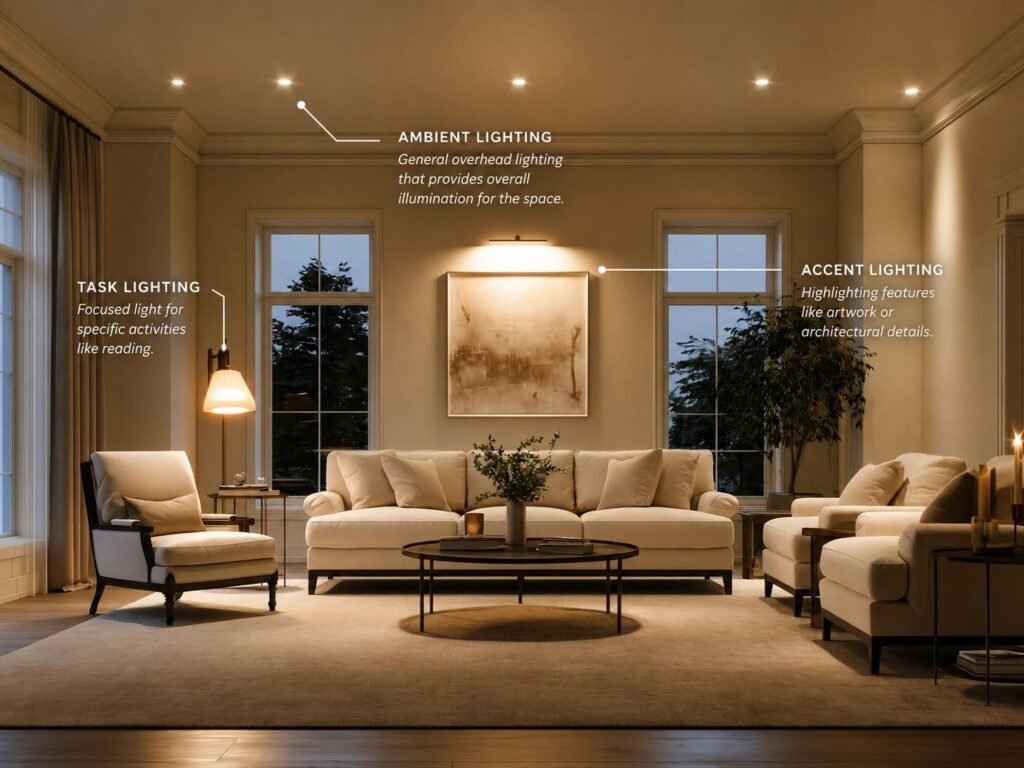
Layered lighting is the practice of combining several types and sources of light within a room rather than relying on a single fixture. A well-designed lighting plan typically brings together ambient, task, and accent lighting, with each layer serving a different purpose.
The goal is not simply to add more light. It is to put the right light in the right place for the way the room is actually used.
The Three Layers of Lighting: Ambient, Task, and Accent
Ambient lighting provides the room’s general illumination. It allows you to move comfortably through the space and establishes the overall level of light. Depending on the architecture, it might come from recessed lighting, ceiling fixtures, chandeliers, pendants, wall sconces, or even indirect sources.
Task lighting is more focused. It illuminates the places where you perform specific activities—reading beside a chair, preparing food on a kitchen counter, working at a desk, or reading in bed.
Accent lighting creates emphasis and visual interest. It might illuminate artwork, shelving, a textured wall, an architectural feature, or another element you want the eye to notice.
The strongest rooms use these layers together rather than expecting one source of light to do everything.
Where Decorative Lighting Fits In
There is also another element I consider: decorative lighting.
A chandelier over a dining table, a sculptural table lamp, or a beautiful pendant can provide useful light, but it also contributes to the composition of the room even when it is turned off.
This is where lighting and interior design overlap. A fixture can become a focal point, reinforce the scale of the architecture, or add character to an otherwise simple space.
The important distinction is that decorative lighting should complement a functional lighting plan—not replace one.
Why One Overhead Light Is Usually Not Enough
One of the most common reasons a room feels flat at night is that nearly all of its light comes from the ceiling.
Overhead fixtures and recessed lights can be very useful, but when they are the only source of illumination, the room often lacks depth and atmosphere. Everything receives light from roughly the same direction, and there is little variation between brighter and quieter areas.
Layered lighting changes that.
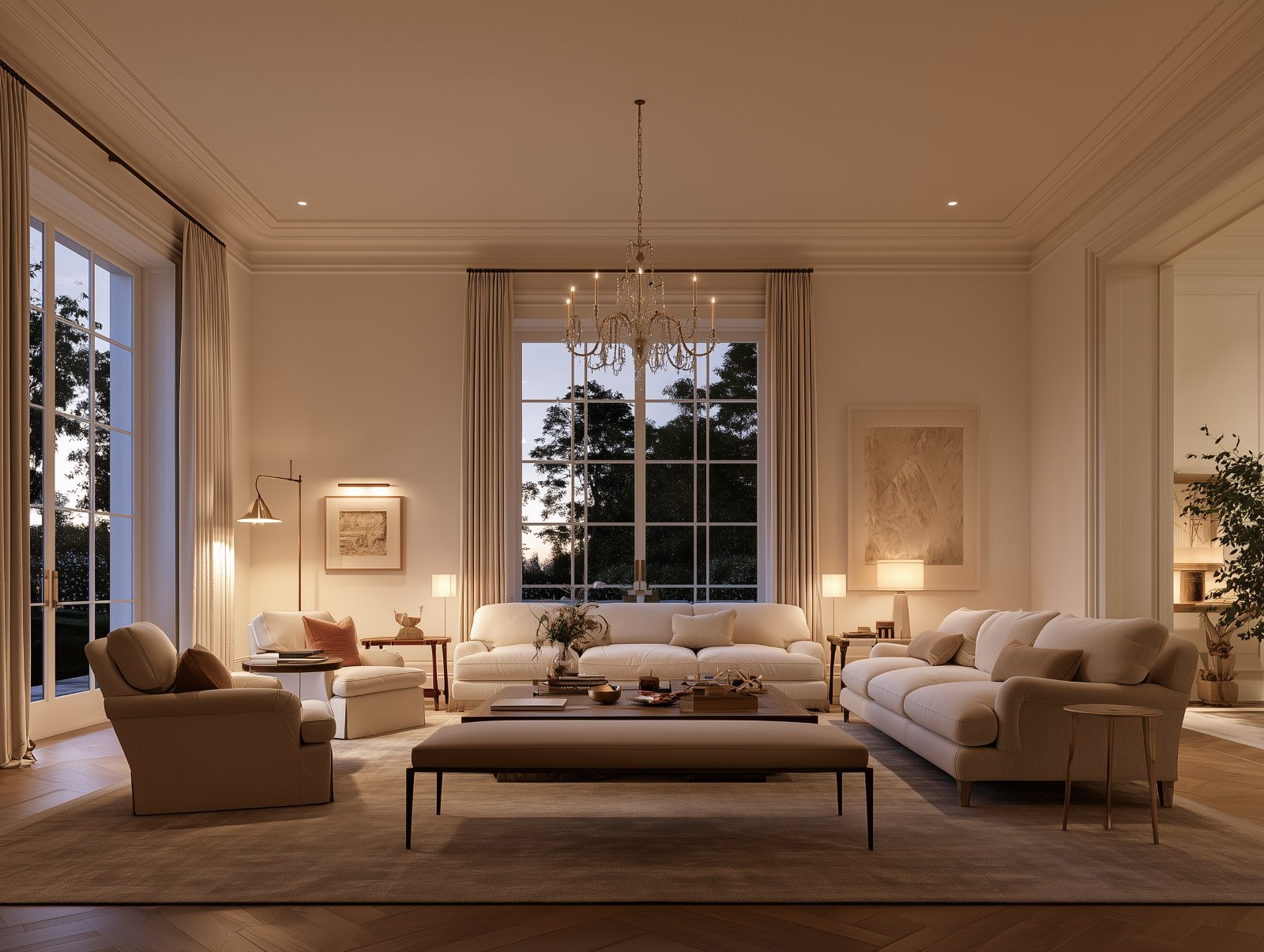
Light at Different Heights Creates Depth
Instead of thinking only about how much light a room has, think about where that light is coming from.
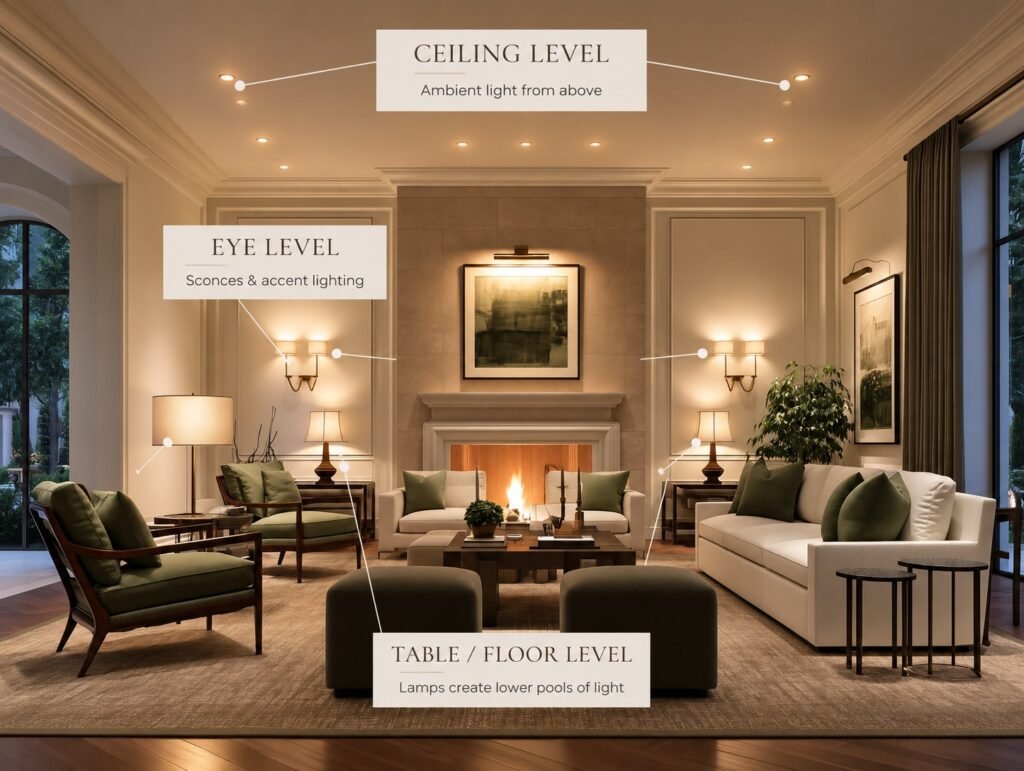
A successful room often has illumination at several levels:
- ceiling level from recessed lights, chandeliers, or pendants;
- eye level from sconces or picture lights;
- seated or table level from floor and table lamps.
This variation creates depth.
It also allows certain areas to recede while others become more prominent. That contrast is important. A room does not need to be equally bright from corner to corner to be well lit.
In fact, some of the most inviting rooms have intentionally quieter areas of light.
How to Layer Lighting in a Room: Start With the Space
When I approach a lighting plan, I prefer to work from the room outward rather than from the fixture inward.
Before choosing lamps or deciding how many recessed lights you need, understand what the space is asking for.
Step 1: Understand the Architecture and Natural Light
Start by looking carefully at the room itself.
Where are the windows? How much natural light enters during the day? Are there areas that become particularly dark in the afternoon or evening? How high is the ceiling? Are there architectural features, artwork, shelving, or textures worth emphasizing?
I also recommend observing the room at different times of day.
A space that feels perfectly bright at noon can become completely different after sunset. Understanding that transition helps you design the artificial lighting for the moments when you actually need it.
Step 2: Identify What Happens in the Room
Next, think about activities rather than fixtures.
Where do people sit?
Where does someone read?
Is there a desk or work surface?
Where do family and guests naturally gather?
Which circulation paths need to remain comfortably illuminated?
This is especially important in multifunctional rooms. A living room, for example, may need to support conversation, reading, television, entertaining, and quiet evenings—all with different lighting requirements.
Function should come before fixtures.
Step 3: Establish the Ambient Lighting
Once you understand the room, establish its general illumination.
Ambient lighting does not necessarily mean installing recessed lights across the entire ceiling. Depending on the architecture, it might come from a central ceiling fixture, indirect lighting, wall sconces, or a combination of sources.
The goal is to create enough general illumination to use and navigate the room comfortably without making it feel overlit.
Step 4: Add Task Lighting Where You Actually Need It
Now consider each activity zone.
A reading chair may need a floor lamp. A desk needs focused light. Kitchen countertops require adequate task lighting. Bedside lighting should allow someone to read comfortably without illuminating the entire room.
Task lighting should respond to what happens in a particular location, not simply to symmetry.
Two identical lamps may look beautiful on a console, but they are not necessarily solving the lighting needs of the room.
Step 5: Use Accent Lighting to Create Visual Hierarchy
Once ambient and task lighting are working, decide what deserves attention.
Perhaps it is a piece of art, a bookcase, an architectural niche, a stone wall, or a beautiful texture.
Accent lighting guides the eye.
This is one of the reasons lighting has such a powerful effect on interiors: it can establish visual hierarchy without adding anything new to the room.
You are simply deciding what should be noticed.
Step 6: Add Decorative Lighting With Intention
Only now do I think about decorative fixtures as part of the overall composition.
This does not mean you cannot fall in love with a chandelier or lamp first—we all do. But before purchasing it, ask what role it will play.
Does it provide ambient or task light? Is it primarily decorative? Is its scale appropriate for the room? What other sources of light will support it?
A beautiful fixture becomes much more successful when it belongs to a complete lighting plan.
How Many Light Sources Does a Room Need?
There is no universal number of lamps or fixtures that every room should have.
Room size matters, but so do architecture, furniture placement, ceiling height, natural light, wall colors, and the activities happening within the space.
Instead of searching for a magic number, I recommend thinking in zones.
A conversation area may need one combination of light, while a reading corner needs another. Artwork may need accent lighting. A dark corner might benefit from a floor lamp or wall sconce.
The question becomes less “How many lights do I need?” and more “Have I illuminated the functions and focal points that matter?”
How Many Lamps Should a Living Room Have?
For many living rooms, a combination of several light sources works better than relying on a single ceiling fixture.
A room might include general ceiling or architectural lighting, a floor lamp near a reading chair or sofa, one or two table lamps, and an accent source for artwork or shelving.
But treat that as a starting point, not a formula.
A smaller living room may need fewer sources, while a large open-plan space may require several lighting zones.
The goal is balance—not a predetermined lamp count.
Where to Place Lamps for Better Layered Lighting
Lamp placement should follow both function and composition.
Place Light Where the Activity Happens
If someone regularly reads in a particular chair, place useful light there.
If a console sits in an otherwise dark area, a table lamp can provide both visual balance and softer evening illumination.
Beside a sofa, a floor or table lamp can make the seating area feel more intimate while providing practical light.
This sounds simple, but it prevents one of the most common decorating mistakes: placing lamps only where they look symmetrical in a photograph rather than where people actually need them.
Avoid Lighting Every Corner Equally
Good lighting does not mean eliminating every shadow.
Contrast helps us perceive depth.
If every surface receives exactly the same intensity of light, the room can begin to feel commercial rather than residential.
Allow some areas to be quieter while using light to emphasize the places where you want the eye to travel.
Use Lighting to Balance the Room
Lighting also carries visual weight.
If one side of a living room becomes very dark in the evening, adding a floor lamp, table lamp, or sconce can make the entire composition feel more balanced.
This is another reason I prefer evaluating the room as a whole rather than selecting each fixture independently.
Choose the Right Color Temperature and Brightness
Beautiful fixtures cannot compensate for unpleasant light.
The terminology can sound technical, but there are two simple ideas to remember:
Kelvin describes how warm or cool the light appears.
Lumens tell you how much light the bulb produces.
Once you understand those two ideas, choosing bulbs becomes much easier.
2700K vs. 3000K: Which Is Better?
Color temperature is measured in Kelvin (K).
For residential interiors, 2700K produces a warmer, softer light that is particularly comfortable in living rooms, bedrooms, and other spaces designed for relaxation.
3000K is still warm, but it appears slightly cleaner and crisper. It can work beautifully in kitchens, bathrooms, and spaces where a little more visual clarity is helpful.
Neither is universally “better.”
The right choice depends on the room, its finishes, its natural light, and the atmosphere you want to create.
In a living room designed to feel warm and inviting in the evening, I generally prefer the softer character of 2700K.

Brightness Matters as Much as Color Temperature
Kelvin tells you the color appearance of the light—not how bright it is.
Brightness is measured in lumens, and choosing the appropriate output matters just as much as selecting the right temperature.
A warm bulb that is far too bright can still make a room uncomfortable, while insufficient task lighting can make reading or working difficult regardless of how beautiful the fixture is.
Think about brightness according to function, then use multiple sources and dimmers to create flexibility.
Keep Color Temperature Consistent Within the Same Visual Zone
One detail that can quickly make an otherwise beautiful room feel disjointed is an accidental mixture of noticeably different color temperatures.
For example, very warm table lamps combined with much cooler recessed lighting can create competing tones within the same space.
There are situations where professionals intentionally mix temperatures, but for most homes, keeping the light reasonably consistent within the same visual zone creates a calmer and more cohesive result.
Use Dimmers to Make Your Lighting Flexible
If there is one relatively simple feature that can dramatically improve residential lighting, it is the ability to control intensity.
A room does not need the same amount of light all day.
The lighting you want while cleaning or working may be completely different from what you want during dinner, while entertaining friends, watching television, or relaxing before bed.
Dimmers allow the same fixtures to support several moods and activities.
I like to think about lighting in terms of scenes rather than one permanent setting.
A good lighting plan should be able to change with the way you live.
How to Layer Lighting in Different Rooms
The principles remain the same throughout the home, but each room requires a different balance because each one serves a different purpose.
Living Room Lighting
The living room is one of the best examples of why layered lighting matters.
It often has several functions within one space: conversation, reading, entertaining, television, and relaxation.
Start with enough ambient light to navigate the room comfortably, then address individual seating and activity zones.
A floor lamp beside a reading chair can provide task lighting. Table lamps near the sofa can create a softer pool of light at seated height. Artwork or shelving may benefit from accent lighting.
Recessed lighting can certainly be part of the plan, but recessed lights alone are rarely the entire solution for a warm, inviting living room.
If you are arranging a living room from the beginning, furniture placement and lighting should be considered together. Your sofa establishes one of the room’s most important activity zones, so its location influences where lamps and other sources will be most useful. My guide to choosing the perfect sofa explores the scale, comfort, and placement considerations that help create a well-planned seating area.
The area rug also plays an important role in defining the furniture arrangement and establishing the visual boundaries of the seating area. My guide to choosing an area rug explains how size and placement can help anchor the entire room.
For a cozier atmosphere in the evening, reduce the overhead light and allow the lower-level sources—table lamps, floor lamps, sconces, and accent lighting—to do more of the work.
Bedroom Lighting
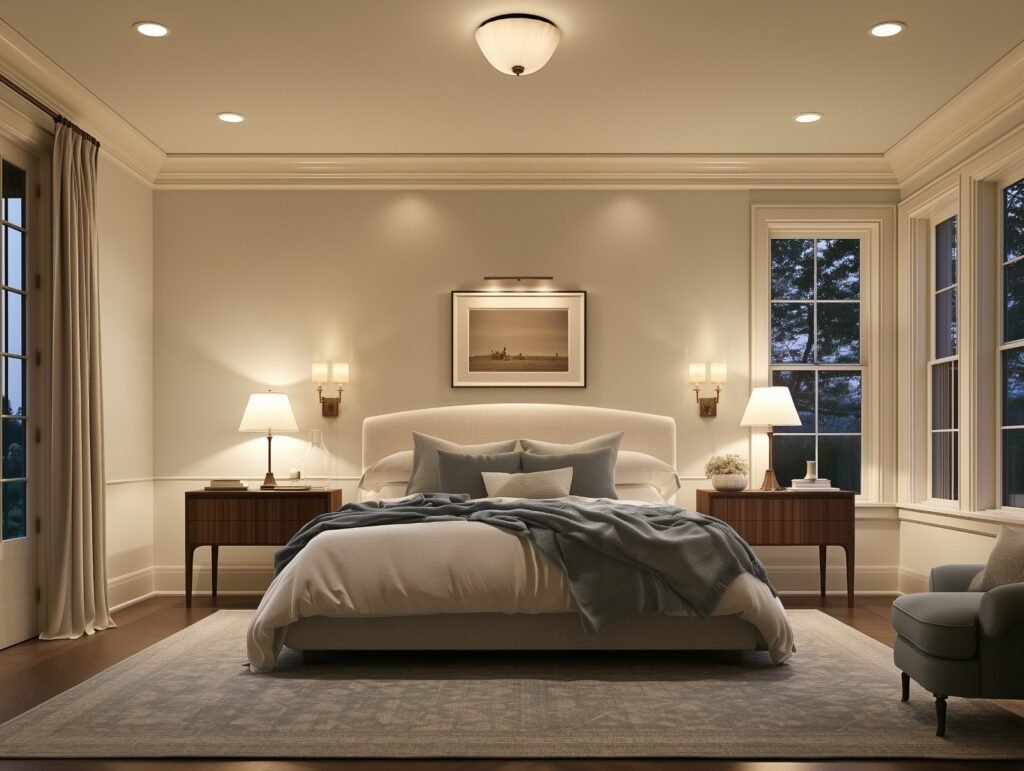
Bedrooms benefit from lighting that can transition from practical to restful.
General ambient light is useful when getting dressed or organizing the room, but bedside task lighting allows reading without illuminating the entire space.
Table lamps, pendants, or wall-mounted sconces can all work beside the bed depending on the architecture and available surface space.
Then consider a softer decorative or accent source that allows the room to settle into a calmer mood in the evening.
The bedroom should never have only one lighting condition.
Kitchen and Dining Lighting
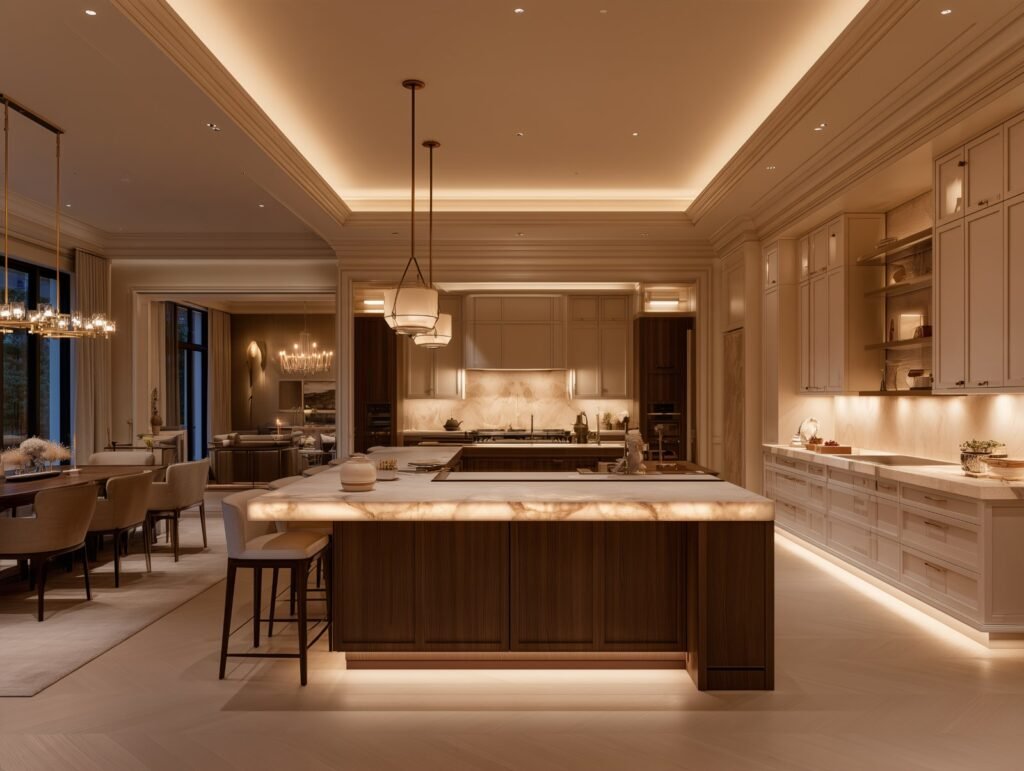
Kitchens and dining rooms often connect visually, particularly in open-plan homes, but their lighting needs are different.
A kitchen requires strong task lighting where food is prepared. Countertops, islands, sinks, and work surfaces should be adequately illuminated rather than depending entirely on general ceiling light.
The dining area is more atmospheric.
A pendant or chandelier can establish the table as a focal point, while dimmers allow the light level to change from a family meal to a more intimate dinner.
When these spaces are adjacent, the fixtures do not need to match, but they should feel as though they belong to the same architectural story.
Can You Layer Lighting Without Overhead Lights?
Absolutely.
In fact, some rooms become especially inviting when their evening lighting comes primarily from sources below the ceiling.
If you rent, cannot modify the electrical plan, or simply have a room without overhead lighting, combine floor lamps, table lamps, plug-in sconces, picture lights, and rechargeable lamps to create illumination at different heights.
Start by making sure the main activities have sufficient light. Then add softer sources to balance darker parts of the room and highlight focal points.
The principle remains exactly the same:
Think in layers and zones rather than searching for one fixture powerful enough to illuminate everything.
Common Layered Lighting Mistakes to Avoid
Even beautiful lighting fixtures can produce disappointing results when the overall plan is missing.
Relying Only on Recessed or Overhead Lighting
Ceiling lighting is useful, but it should not be expected to create every layer of the room.
Add lower and more focused sources to create dimension and flexibility.
Using the Same Brightness Everywhere
A home does not need to look like a uniformly illuminated showroom.
Different levels of brightness create hierarchy and atmosphere.
Choosing Fixtures Before Understanding the Room
A fixture may be beautiful on its own and still be wrong for the space.
Consider function, scale, architecture, and the existing lighting plan before making the selection.
Mixing Color Temperatures Without Intention
Bulbs that produce visibly different tones can make a room feel inconsistent.
Choose color temperatures deliberately, particularly when multiple fixtures are visible at the same time.
Ignoring Scale and Fixture Height
Lighting has a physical relationship with the architecture and furniture around it.
A chandelier that is too small can disappear in a large room, while one hung at the wrong height can interfere with sightlines or feel disconnected from the furniture below.
The correct dimensions depend on the room and fixture, which is why I prefer proportion and context over universal rules.
Making Every Lamp Match
Your lamps do not need to come from the same collection.
In fact, a room often feels more collected and sophisticated when lighting coordinates without matching exactly.
Look for relationships in material, finish, shape, scale, or overall character rather than buying identical fixtures simply for consistency.
A Simple Layered Lighting Checklist
Before considering a room’s lighting complete, walk through these questions:
- Architecture: What does the room itself require?
- Natural light: How does the space change from day to night?
- Function: What activities happen here?
- Ambient: Is there comfortable general illumination?
- Task: Does each important activity have adequate light?
- Accent: What should the eye notice?
- Decorative: Do the fixtures contribute to the room’s design?
- Height: Is the light distributed at more than one level?
- Color and brightness: Are Kelvin and lumens appropriate and cohesive?
- Controls: Can the lighting change for different activities and moods?
If you can answer those ten questions, you are no longer simply choosing lamps. You are creating a lighting plan.
Layered Lighting FAQs
What are the three layers of lighting?
The three primary lighting layers are ambient, task, and accent lighting. Ambient lighting provides general illumination, task lighting supports specific activities, and accent lighting highlights selected architectural or decorative features.
Does every room need all three layers of lighting?
Not necessarily. The number and type of layers should respond to the room’s function, architecture, and size. A simple space may require fewer sources, while a multifunctional living room will usually benefit from a more developed layered lighting plan.
How many lamps should a living room have?
There is no fixed number. Rather than counting lamps, identify the room’s seating, reading, conversation, and focal-point zones and make sure each has the appropriate light. Many living rooms benefit from several sources positioned at different heights.
Can you layer lighting without overhead lights?
Yes. Floor lamps, table lamps, plug-in sconces, picture lights, rechargeable lamps, and other sources can create effective layered lighting without a ceiling fixture. The key is distributing light according to function and at different heights.
Is 2700K or 3000K better for a living room?
For most living rooms, I prefer 2700K because its warmer character creates a comfortable evening atmosphere. However, 3000K can work well in contemporary spaces or where slightly crisper light complements the finishes and overall design.
Should all lamps in a room match?
No. Lamps should coordinate with the room and with one another, but they do not need to match. A thoughtful mix of shapes, materials, and scales often creates a more collected interior than a perfectly matched set.
Do you need dimmers for layered lighting?
They are not essential for every fixture, but dimmers are one of the most useful tools for creating flexible lighting. They allow a room to transition between brighter functional light and softer evening illumination without adding additional fixtures.
Final Thoughts: Design the Light Around the Way You Live
Learning how to layer lighting is not about filling a room with more fixtures.
It is about understanding the architecture, recognizing how the space is used, and placing the right kind of light where it can make a meaningful difference.
Start with function. Build the ambient layer. Add task lighting where activities require it. Use accent light to establish hierarchy. Then choose decorative fixtures that strengthen the composition rather than trying to solve the entire room on their own.
Most importantly, remember that a well-designed home changes throughout the day.
The lighting should be able to change with it.
When light is considered as carefully as furniture, materials, and proportion, it does something more than illuminate a room—it allows the architecture and everything within it to be experienced as they were meant to be.